
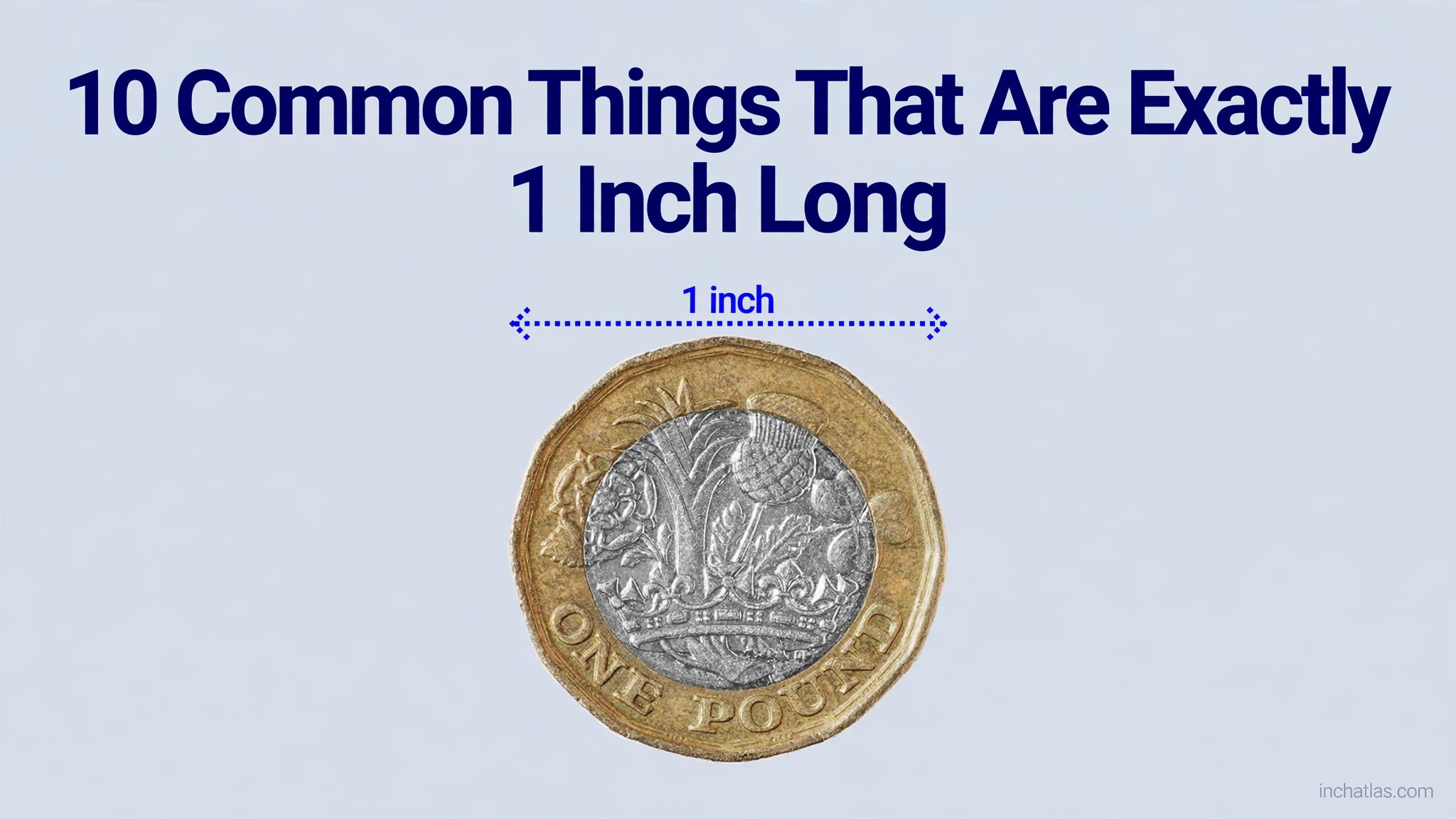
How long is 1 inch? Exactly 2.54 centimetres — 25.4 millimetres, or one-twelfth of a foot. It is one of the smallest lengths you will ever measure, yet it turns up everywhere: in the screws on a pair of glasses, the coins in your pocket, the fittings around the house.
Quick Answer
1 inch
= 2.54 cm = 25.4 mm
Also: 0.0833 ft · 0.0254 m · 0.0278 yd
Once you know what an inch looks like, you start spotting it all over the place. At 0.0833 feet and 0.0254 metres, it sits neatly between the width of your thumbnail and the length of a matchstick. This guide gives you ten real objects that measure about an inch, so you can judge the length at a glance without reaching for a ruler.
Related Post: 11 Common Things That Are Exactly 2 Inches Long
How Long Is 1 Inch in Other Units
| Unit | 1 inch equals |
|---|---|
| Inches | 1 in |
| Centimetres | 2.54 cm |
| Millimetres | 25.4 mm |
| Feet | 0.0833 ft (1/12 ft) |
| Metres | 0.0254 m |
| Yards | 0.0278 yd |
The centimetre figure is exact by international agreement: since 1959, one inch has been defined as precisely 2.54 centimetres, so every other conversion follows from that single number. Twelve inches make a foot, thirty-six make a yard, and a metre holds just over thirty-nine inches.
Everyday Things That Are About 1 Inch Long
1. A Standard Guitar Pick

A standard guitar pick is a small, flat piece of plastic with a round base and a pointed tip. Players hold it between thumb and forefinger and use the point to pluck or strum the strings of a guitar. A standard pick measures about 30 millimetres from the round base to the tip. That works out at roughly 1.18 inches, so it runs just a little longer than a true inch. The width across the base is about 25 millimetres, which is almost exactly one inch, so the pick gives you two useful measures in one small object.
That makes it a handy thing to keep in mind when you need to judge an inch. If you play guitar, you will already have one in a drawer, a pocket or a case. Even if you never play, picks are cheap and easy to find in any music shop, and they come in bright colours that are hard to lose. Pick one up and hold it flat against the thing you want to measure. The pointed tip gives you a clear end point, and the round base gives you the other. Compare the two ends and you will see at once whether your object is shorter, longer or about the same length. A quick tip: keep a pick in your desk drawer or with your phone charger. It takes up no space, and it is always there when a screw, a gap or a small part needs a quick check. Once you have seen a pick next to a ruler, the length stays in your head, and you can picture it any time you need it.
2. A One-Pound Coin
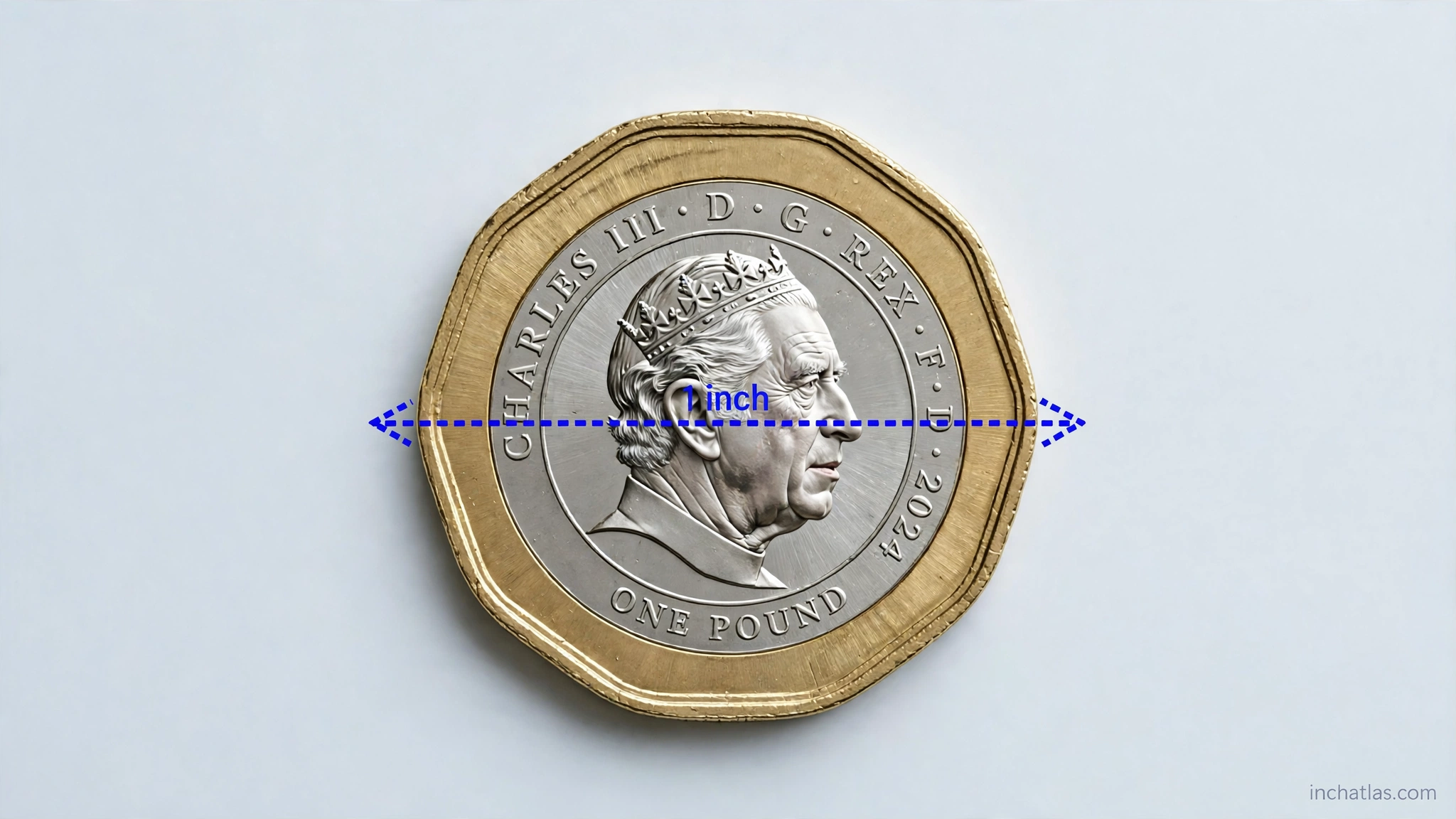
The British one-pound coin is one of the easiest inch guides you will ever find, because most people in the UK carry one in a pocket or a purse. The coin has twelve sides and a gold outer ring with a silver centre. It measures 22.5 millimetres across, which is 0.89 inches. That is just a fraction under a full inch, so if the thing you are measuring matches the coin edge to edge, you know it is a touch under an inch.
The coin is easy to spot by touch as well as by sight. Its twelve-sided edge feels different from every round coin in your change, and its gold colour stands out among the silver coins around it. That means you can find it without even looking, which is useful when your hands are full. Hold the coin flat against the gap, the screw or the part you want to size up. Line up one edge of the coin with one end of the object, then look at where the other end falls. If the object runs a little past the coin, it is about an inch. A quick tip: keep a pound coin in a small dish by your front door or in your desk drawer. It works as loose change and as a pocket ruler in one. Once you know the coin is just under an inch across, you will find yourself reaching for it whenever a small measure comes up.
3. A Large Marble

A large glass marble, the kind sold as a shooter, is a smooth ball of glass with swirls of colour inside. Children have played with marbles for years, and many homes still have a bag of them in a drawer or a toy box. A large marble measures 25 millimetres across, which is 0.98 inches. That is as near to a true inch as any round object gets.
Marbles are useful because they are perfectly round, so every way across is the same. There is no long side and no short side to confuse you. Turn the marble any way you like and the measure stays the same, which makes it one of the cleanest pictures of an inch you can find. Hold the marble next to the thing you want to measure and compare the two widths. If they match, you have your inch. A large marble is also easy to carry in a pocket, and it will not bend or wear out like a paper strip. A quick tip: if you buy marbles, check the size on the pack before you pay. Small marbles are much less than an inch across, and only the large 25-millimetre kind gives you the right measure. Keep one large marble with your other small tools. It costs almost nothing, and it turns a guess into a real check in seconds.
Related Post: 12 Common Things That Are Exactly 3 Inches Long
4. A Wine Cork’s Diameter

Pull the cork from a bottle of wine and look at its flat end. A standard natural cork is about 24 millimetres across, which is 0.94 inches. That is just a touch under an inch, so the round end of a cork is a fine guide when you need a quick measure. Corks are good for this because they are made to a set size. Wine bottles are sealed to the same size all over the world, so a cork from one bottle matches a cork from any other. You do not need to hunt for a special one.
The cork is also light and easy to hold, with flat ends and straight sides that give you two clean edges to judge by. Hold the flat end of the cork against the gap or the part you want to size up. If the two match, you have found your inch. A quick tip: keep a cork or two in a kitchen drawer after your next bottle of wine. They cost nothing, they last for years, and they are always at hand when a small job comes up. You can also use the cork to test a hole or a slot. If the cork slides in with a little room to spare, the hole is just over an inch wide. If it will not fit at all, the hole is under an inch. That simple test saves you from reaching for a ruler.
5. A Standard SIM Card

The standard SIM card is the full-size card that phones used for years before smaller cards took over. It is a small white plastic card with a gold chip in the middle, and most of us have handled one while setting up a new phone. A standard SIM measures 25 millimetres long and 15 millimetres wide. Its longest side is 0.98 inches, which is as near to an inch as makes no real difference.
The card is flat and stiff, with straight edges and square corners, so it is easy to lay it flat against the thing you want to measure. Line up one end of the card with one end of the object and see where the other end falls. If they line up, you have your inch. The gold chip also gives you a clear centre point if you need to find the middle of something. If you still have an old SIM in a drawer, keep it by your desk as a quick check. It takes up no room, and it is always there when you need it. A quick tip: many phone shops will give you an old SIM card for free if you ask, and old phones often have one still sitting in the tray. If you want to see that length doubled, look at the 2 inches we measured next.
6. A Domino’s Width

A standard domino is a small black tile with rows of white dots, and most people know it at a glance. A full set has been a common game in homes for years, and a single tile is easy to find in a toy box or a games cupboard. A standard domino measures 50 millimetres long and 25 millimetres wide. Its short side is exactly one inch, which makes it a rare thing in this guide: a perfect inch with no rounding at all.
The tile works as a double guide. Its width is one inch and its length is two inches, so one tile measures both at once. Lay the tile flat and use its short edge to check an inch, then turn it round and use its long edge to check two inches. The flat sides and square corners make it simple to line up against a shelf edge, a strap or a gap. A quick tip: keep one domino in a drawer with your other small tools. It is flat, strong and cheap, and it will not wear out. If you play dominoes, you already have a full set of inch guides in the box. Next time a game ends, leave one tile out on purpose. It will be there the next time a small measure comes up, and it will do the job better than a guess.
7. A C-Cell Battery’s Diameter

A C-cell battery is the round cylinder that powers torches, toys and radios in many homes. It is wider than an AA battery and shorter than a D battery, and its blue or black case is easy to spot in a drawer. A C-cell measures 26.2 millimetres across, which is 1.03 inches. That is just a hair over a true inch, so if something spans the same width as the battery, you can call it an inch.
The flat ends of the battery give you two clean edges to judge by. Hold the battery upright and look at its width, or lay it on its side and roll it against the thing you want to measure. Either way, the round shape stays the same, so there is no wrong way to hold it. Most homes have a spare C-cell in a drawer, and shops sell them in packs of two or four for very little money. A quick tip: check the label before you use a battery as a guide. An AA battery is much thinner, and a D battery is much wider, so only the C size gives you the inch. Keep a spare C-cell with your torch or your other batteries. It will power a radio when you need it, and it will also serve as a solid inch guide whenever a small measure comes up around the house.
8. A Small Padlock

A small padlock is the kind used on a diary, a luggage zip or a shed hasp. It has a brass body and a curved shackle on top, and it is a shape most people know at once. The body of a small padlock measures about 25 millimetres wide, which is right on one inch.
Padlocks are useful as a guide because they are rigid and regular. The body has flat sides and square corners, so the width is simple to judge against a shelf edge, a strap or a gap. There is no bend or curve to trick your eye. Hold the padlock flat against the thing you want to measure and compare the two widths. If they match, you have your inch. The shackle on top is a bonus: it gives you a curved loop that is handy for testing small holes and rings. A quick tip: keep a small padlock in a drawer even if you do not use it to lock anything. It is cheap, strong and easy to find, and it works as a solid inch guide whenever you need one. If you travel, the padlock on your bag already gives you a measure you can use on the move. Once you know the body is an inch wide, you will find yourself checking it against straps, buckles and small parts without thinking.
9. A Small Safety Pin
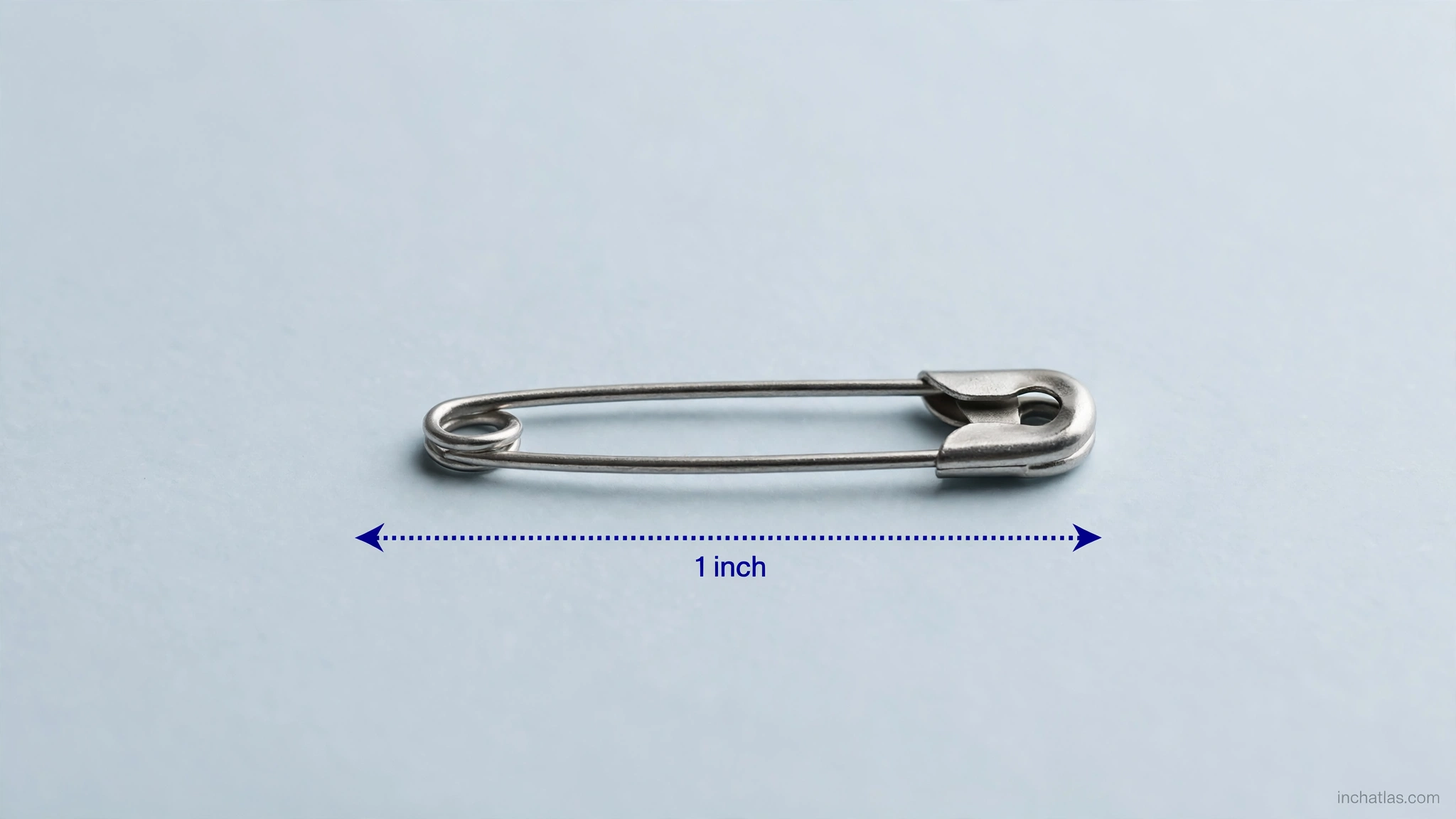
A small safety pin is a thin piece of wire bent into a loop, with a coil at one end and a clasp at the other. A size 1 pin measures about 27 millimetres long, which is 1.06 inches. That is just a little over a true inch, so it gives you a close guide with a small margin to spare. The coiled spring at one end and the clasp at the other give the pin two clear ends, so the full length is simple to see. There is no doubt about where the pin starts or stops, which is what makes it a good guide.
Its slim shape suits narrow measures, like the width of a seam, a hem or a small gap. Lay the pin flat next to the thing you want to check and compare the two ends. If the object is a little shorter than the pin, it is about an inch. A quick tip: keep a few safety pins in a sewing box or a small tin. They cost almost nothing, and they are useful for far more than measuring. You can use one to hold a hem in place, to fix a loose button or to keep a strap from slipping. And if you want to see that length doubled, look at the 2 inches we measured next. Once you know the pin is just over an inch, it becomes a small tool you will reach for again and again.
10. A Standard Key Ring

A standard key ring is a loop of steel wire wound into two turns, made to hold a set of keys together. A 25-millimetre split ring measures 0.98 inches across, which is as near to an inch as makes no real difference. Key rings are made to fixed sizes, so one ring matches another no matter where it was bought. That is what makes them so reliable as a guide.
Hold the ring flat against the thing you are sizing up. If the ring covers it edge to edge, you are looking at about an inch. The round shape is a help too: there is no long side or short side, so you cannot hold it the wrong way round. The ring is also easy to find. Most of us carry one every day, and a spare ring costs very little in any hardware shop or market stall. A quick tip: keep a spare ring in a drawer with your other small tools. It will hold a new set of keys when you need it, and it will serve as an inch guide in the meantime. Three in a row add up to 3 inches. Once you know the ring is an inch across, you will find it is one of the handiest measures you own.
How to Visualise 1 Inch
The fastest way to picture an inch is your own thumb. For most adults, the width of the thumb across the nail is roughly an inch — press your thumb against the edge of a page and you have a built-in ruler that never leaves your hand. Check yours against a real ruler once, and remember whether your thumb runs slightly wide or narrow.
Coins are the next best guide: a one-pound coin is just under an inch across, and most people can picture one without thinking. Your phone helps too — most phones are about three inches wide, so a third of the screen’s width is close to an inch. Put two or three of these references together and your estimate will be good enough for anything short of carpentry.
Frequently Asked Questions
How long is 1 inch in centimetres?
One inch is exactly 2.54 centimetres. The figure is exact by international agreement, not a rounded estimate.
How many millimetres are in 1 inch?
There are 25.4 millimetres in one inch. Multiply inches by 25.4 to get millimetres; divide millimetres by 25.4 to get inches.
How long is 1 inch in feet?
One inch is one-twelfth of a foot — 0.0833 feet. Twelve inches make exactly one foot.
What everyday object is exactly 1 inch long?
A large 25-millimetre marble and a standard SIM card both measure 0.98 inches, while a domino is exactly one inch wide. A one-pound coin comes close at 0.89 inches.
How can I measure 1 inch without a ruler?
Use the width of your thumb across the nail, about an inch for most adults, or a one-pound coin, just under an inch across. A large marble or a key ring works too.
Is 1 inch the same as 2.54 cm everywhere?
Yes. Since 1959 the inch has been defined internationally as exactly 25.4 millimetres, so the conversion holds everywhere.
Conclusion
An inch is small, but it is far from abstract. From a guitar pick to a key ring, the objects in this guide put a real, holdable shape to a measurement most of us only meet as a number. Once you have handled two or three of them, you will find you can judge an inch at a glance.
The next time a label, a screw or a gap calls for an inch, reach for one of these everyday references instead of a ruler. Your thumb, your pocket change and the contents of a kitchen drawer already carry the measurement with them — and now you know exactly where to find it.

Founder of InchAtlas. He writes the guides, turning everyday sizes into clear, exact conversions and comparisons you can picture at a glance.
3 thoughts on “10 Common Things That Are Exactly 1 Inch Long”